Traditional chemical pricing methods are no longer enough in volatile markets. Chematrics explores how transparent market signals and quantitative data can reshape petrochemical decision-making.
One of the most common questions we hear when introducing Chematrics is simple:
“Where are you going with this?”
It’s a fair question. But behind it lies a much bigger one that many professionals in petrochemicals are struggling with today:
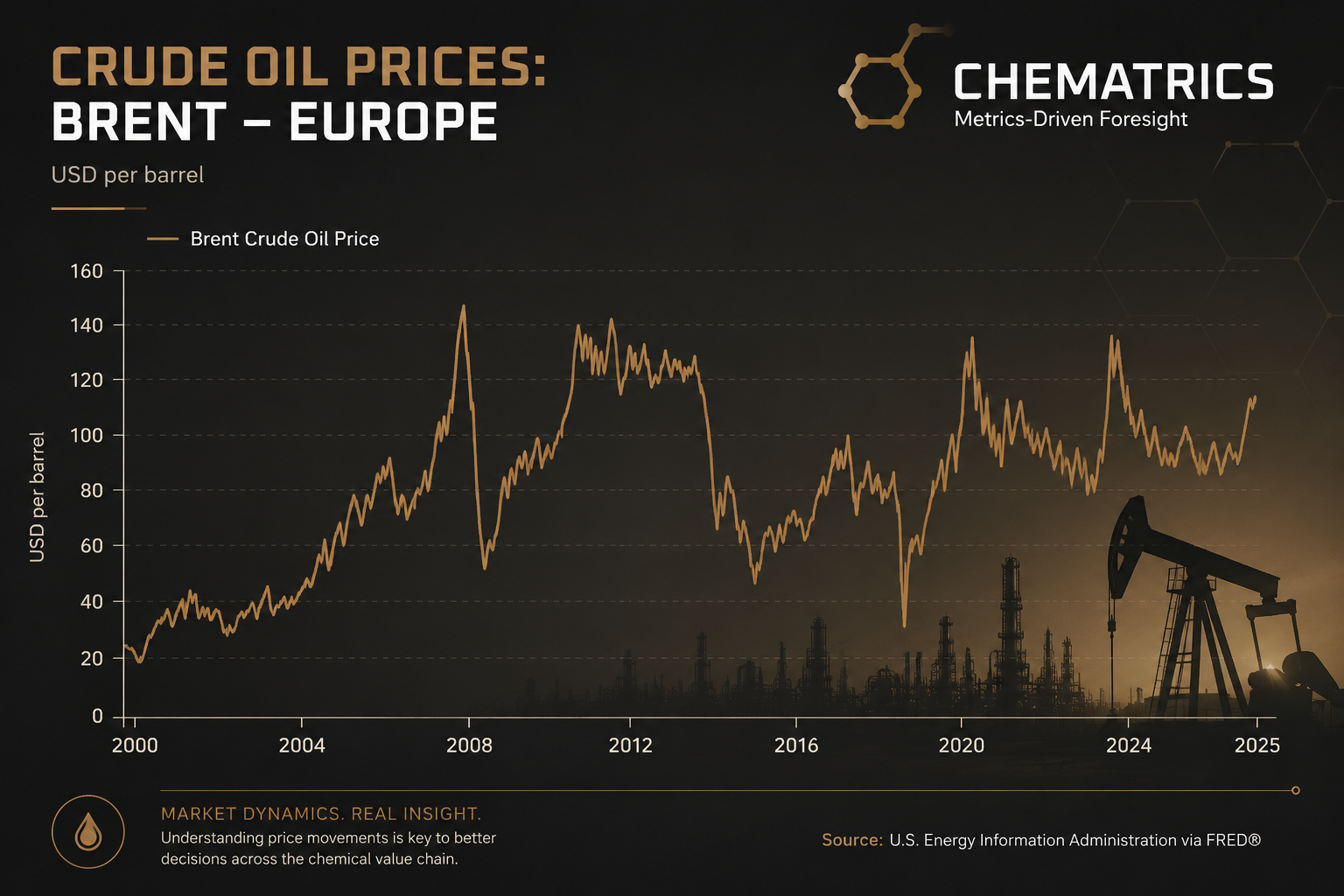
Over the past decade—and especially in the last six years—the petrochemical industry has undergone structural changes that have fundamentally reshaped how markets behave. Pricing dynamics that once felt predictable have become increasingly volatile, influenced by geopolitics, supply chain disruptions, inflationary pressure, and shifts in global demand.
For professionals working in chemical intermediates, resins, and downstream applications such as coatings, adhesives, sealants, and elastomers, this creates a growing challenge: making confident decisions in an environment where traditional benchmarks no longer tell the full story.
Historically, chemical pricing has relied heavily on reported or assessed values. These are often gathered through market surveys, phone calls, and qualitative inputs from industry participants. While these methods have long served as a reference point, they are increasingly limited in today’s fast-moving markets.
They capture what has happened—but rarely reflect real-time market intent.
As a result, procurement teams, traders, and commercial decision-makers are often left asking the same questions:
Without clear answers, even well-informed strategies can quickly become misaligned with market reality.
This is where Chematrics takes a fundamentally different approach.
Rather than relying primarily on interpreted or delayed data, we focus on capturing observable market behavior. By structuring and analyzing bids, offers, and actual transactions, we provide a more transparent view of how market participants are positioning themselves in real time.
This shift—from reported pricing to real market signals—creates a more dynamic and actionable understanding of chemical markets. It allows decision-makers to move beyond static benchmarks and instead interpret how supply and demand are evolving as they happen.
In a market where timing and positioning can significantly impact profitability, this difference is not incremental—it is structural.
Chematrics starts with a focused scope: chemical intermediates that serve as key inputs for industrial applications. Our initial product coverage includes materials such as Methyl Methacrylate, Butyl Acrylate, 2-Ethylhexyl Acrylate, Vinyl Acetate Monomer, and Styrene Monomer.
These building blocks are central to the production of resins used across coatings and related industries, making them highly relevant for both upstream and downstream decision-making.
By combining pricing visibility with forward-looking insights, we aim to answer not just what the market is today—but where it is heading and why. This includes understanding whether current price levels are structurally supported, or whether they are likely to shift under changing supply-demand conditions.
A key part of the Chematrics vision is not only to improve how markets are understood, but also how participants interact within them.
Through our platform, buyers and sellers will be able to engage in a more transparent way, contributing directly to the data that underpins pricing benchmarks. This creates a feedback loop in which market activity continuously strengthens the quality and reliability of the insights provided.
In contrast to traditional methodologies that depend on filtered inputs, this model reflects the unfiltered voice of the market itself. The result is a pricing environment that is both more transparent and more closely aligned with actual trading behavior.
Looking ahead, Chematrics aims to become more than a pricing tool. The broader ambition is to support companies in evaluating their commercial strategies across cycles, helping them understand how procurement, sales, and investment decisions perform under different market conditions.
For example, increasing spot exposure may deliver strong results in a long market, but can quickly become a risk when conditions tighten. Being able to assess these dynamics in advance is critical for building resilient strategies.
By combining quantitative modeling with deep industry expertise, Chematrics seeks to provide a structured framework for navigating this complexity.
We are currently preparing to launch the beta version of the Chematrics platform by the end of the second quarter. Early participants will have the opportunity to engage directly with the system, contribute to its development, and gain early access to a new way of understanding chemical markets.
For those actively involved in petrochemical trading, procurement, or strategic decision-making, this represents an opportunity to move ahead of traditional approaches and engage with a more transparent and data-driven model.
We are moving toward a market where pricing is no longer something you observe after the fact, but something you understand as it forms.
A market where decisions are not based solely on reported benchmarks, but on real, observable signals.
And ultimately, a market where complexity does not disappear—but becomes manageable.